
When ANSI/AAMI ST108 arrived in 2023, it became the first national standard for the water used to clean, rinse, and sterilize surgical instruments — and most sterile processing departments weren’t ready for it. If you run an SPD in a hospital, a surgery center, or an endoscopy suite, the water feeding your washers, your final rinse, and your steam generator is now held to a defined standard, and surveyors are checking against it.
Here’s a fast, honest self-check. Five questions that tell you whether your water would pass an ST108 survey today — before a surveyor answers them for you.
1. Do you have Critical Water — or just a softener?
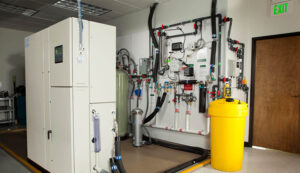
ST108 defines two grades of water. Utility Water — treated tap water — is fine for washing and intermediate rinsing. But the final rinse of critical devices and the feedwater for your steam generator require Critical Water, and a water softener does not get you there. Critical Water needs multi-stage treatment: softening, carbon filtration, reverse osmosis, usually deionization, plus UV and submicron filtration in a recirculating loop. If your treatment stops at a softener, you have a gap.

2. Are you testing endotoxin — every month?
Critical Water has to stay under 10 EU/mL endotoxin and under 10 CFU/mL bacteria, and ST108 expects that verified monthly, at both the water generation system and the point of use. Endotoxin is the parameter tied to the patient-safety risks the standard was written to prevent, and it’s the test facilities most often skip. If you’re not running monthly endotoxin and bacteria panels on your Critical Water, you aren’t demonstrating compliance — even if the water is fine.
3. Is your final rinse actually Critical Water?
Here’s a common trap: a facility treats its wash water reasonably well but rinses critical instruments with Utility Water. ST108 requires Critical Water for the final rinse of critical devices before sterilization. If the last thing that touches an instrument before the autoclave isn’t Critical Water, the cycle is compromised no matter how good the sterilizer is.
4. Can you produce the documentation?
At survey, your equipment is only half the question — the other half is proof. ST108 expects documented monitoring logs, IQ/OQ/PQ validation of your system, and records showing the water met spec over time. Facilities with a perfectly good system take findings all the time simply because they can’t produce the paperwork. If your records live in scattered binders — or nowhere — that’s a gap a surveyor will find.
5. Do you have a written response plan for a failed test?
ST108 expects you to know what happens when a result comes back out of spec: investigation, corrective action, and quarantine of any instruments processed with non-conforming water. Having that plan documented before a failure occurs is itself a survey expectation. “We’d figure it out” is not a plan.
What ST108 actually asks for, in short
Utility Water for washing (bacteria under 500 CFU/mL). Critical Water for the final rinse and steam (bacteria under 10 CFU/mL, endotoxin under 10 EU/mL, conductivity under 10 µS/cm) — verified through a documented monitoring program and a validated system. Two grades, clear limits, and the records to prove them.

Why it matters
This isn’t paperwork for its own sake. ST108 exists because water is a patient-safety variable — endotoxin left on instruments is linked to inflammatory reactions like TASS, and mineral or chloride contamination corrodes and damages surgical tools. And because The Joint Commission, AAAHC, and QUAD A now fold ST108 into their survey criteria — with CMS tying Medicare participation to accreditation — a water finding can put your accreditation itself at risk.
Where we come from
One note on perspective: HydroCare has built and monitored water for dialysis — the most demanding water application in healthcare — since 1999, at endotoxin limits far stricter than ST108 requires. When the standard arrived in 2023, it wasn’t new to us. It’s the same engineering and discipline we’ve delivered for over two decades, now applied to sterile processing.
How did you score? If you answered “no” or “not sure” to even one of these five, you have a gap worth finding before a surveyor does. HydroCare runs a free ST108 Readiness Assessment — a 30-minute review of your water system, Critical Water, and documentation against the standard, with a plain-English pass/fail and a prioritized list of exactly what to fix.